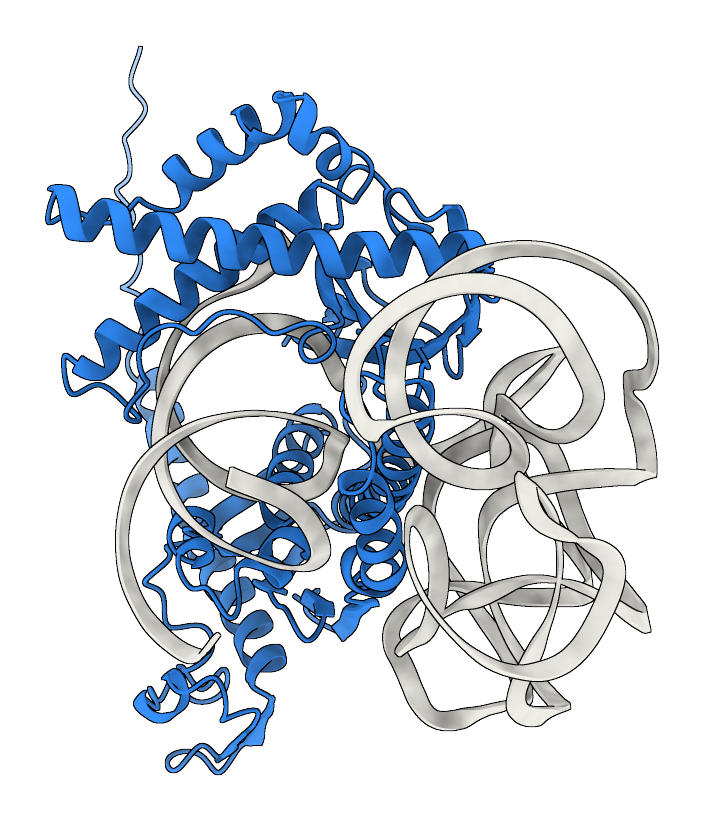
In August we posted the ACE preprint, and I wrote about what we found. In short, we made a compact gene editor designed with AI, only around 60 percent identical to its natural parent, that edits the human genome. This post is about the part I left out, namely how the search was actually run, what it cost in compute, and why the number we care about most is working editors per GPU hour.
The short version of the science
CRISPR-Cas gene editors are big proteins, and the vehicles that carry them into cells have limited room. Most of the field has gone looking in nature for smaller ones. We designed them instead, starting from TnpB, a compact nuclease about 400 amino acids long, less than a third the size of SpCas9.
We gave ESM3 three kinds of information, combining evolutionary signal, structure, and measurements from our own platform of how single changes to the protein affect editing in human cells. Those measurements fix the positions the model may touch and steer it toward the regions of sequence space where activity lives. We never retrained the model. From 36,000 designs we built 44, and six were active. The best of them edited four natural sites in the human genome at levels that matched or beat established compact editors.
Why compute is the real constraint
A protein of 400 amino acids has more possible sequences than there are atoms in the observable universe. A generative model is useful because it narrows that to a shortlist. But every sequence it generates costs GPU time before anyone decides whether to build it, and every one you build costs lab time.
So the yield that matters is not actives per design tested. It is actives per design generated, because that is what each GPU hour buys. Three of our six working editors came from a steered campaign of just 4,500 designs, roughly one working editor per 1,500 sequences generated. Raise that yield and the same compute covers more of the useful search space. Raise it enough and harder problems, like enzymes with several domains, come within reach.
Innovation accelerated by NVIDIA
The design campaigns ran on NVIDIA A100 Tensor Core GPUs. Acrobat, a member of the NVIDIA Inception program, has also integrated NVIDIA BioNeMo into its design workflows. For example, after design generation, the Acrobat team leverages the BioNeMo platform to integrate frontier models into their design filtering pipelines without needing to host the models on their own GPU machines.
For a small team, that last point is the practical one. Generation and filtering are different workloads. Generation is ours to run and tune, and it is where our GPUs should be busy. Filtering wants the best available models, which change every few months, and standing each one up on our own hardware would eat the time we would rather spend on the next campaign. BioNeMo lets us treat those models as a service and keep our own GPUs on generation.
With emerging tools like BioNeMo, we think biological foundation models are limited less by architecture than by the data used to condition them. We are building the data layer that makes those models useful for genetic medicine and beyond. ACE is a demonstration of what that buys you.
What comes next
In August I made a claim that if our steering methods generalize, the advantage goes to the groups that can generate the right experimental data, not to those with the largest model. The compute side is what makes that bet affordable. Better data raises yield per design. Higher yield means each GPU hour returns more working molecules. That is how a company our size takes on larger targets with several domains. We plan to keep doing it on NVIDIA hardware with BioNeMo in the loop.
You can read the preprint and see the full data on bioRxiv.
If you run design campaigns of your own, build within the NVIDIA Inception program, or want to compare notes on yield, we would like to hear from you.